
How Much Does It Cost to Make a Mobile Game in 2026?

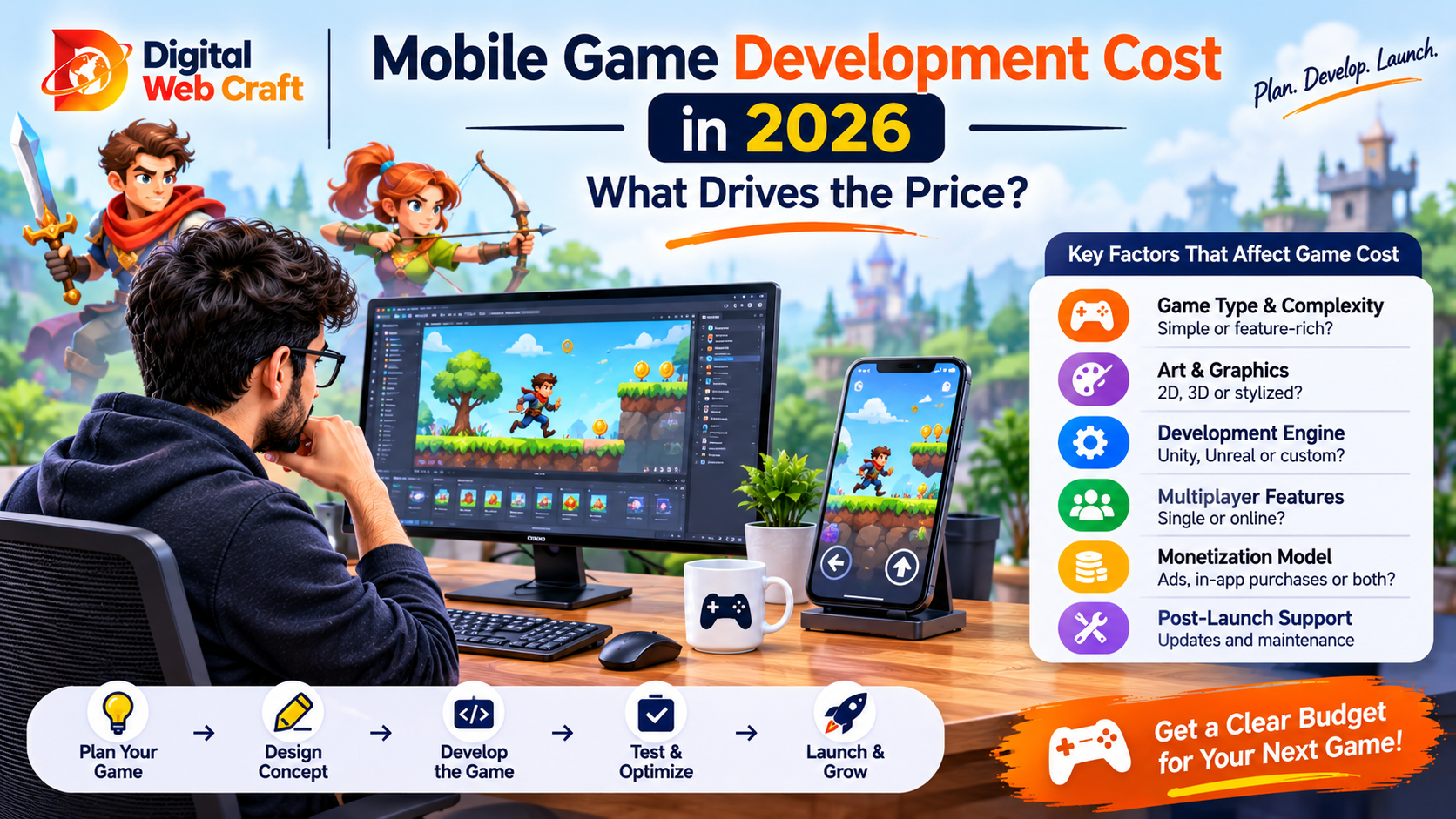
Ask ten game developers what a mobile game costs, and you will get ten different answers, none of them wrong. A tiny hyper-casual puzzle built in a few weeks and a polished 3D multiplayer game with live events are both “mobile games,” yet they differ in cost by a huge margin.
The honest way to answer the question is to look at what makes a game expensive and where your idea sits. This guide breaks down every major cost driver: game type, art, engine, design, multiplayer, monetization, testing, launch and the costs that continue after release. We do not quote dollar figures, because a number copied from a generic article is rarely right for your project. Instead you will learn how to build a realistic estimate for yours.
Key Takeaways
- Mobile game cost depends mainly on game type, art style and quality, features, platforms and team experience.
- Art, animation and sound often take the largest share of a game budget, especially for 3D games.
- Multiplayer, live events, online economies and accounts add backend work that many first-time founders underestimate.
- Choosing an engine such as Unity can lower cost, but the engine does not decide the price, scope does.
- Free-to-play games usually cost more after launch than before, because of marketing, updates and live operations.
- A small, polished prototype is the best way to test an idea before committing a full budget.
- Soft launching in a limited market helps you improve retention and monetization before paying for large-scale marketing.
- Hidden costs include licences, tools, store fees, analytics, customer support and user acquisition.
- Cutting scope is usually safer than cutting quality or testing.
- Treat the budget as phased: prototype, vertical slice, soft launch, global launch and live operations.
Table of Contents
- The short answer
- What you are paying for
- Game type and scope
- Art, animation and audio
- Game design and prototyping
- Choosing an engine
- Programming and features
- Multiplayer, backend and live operations
- Monetization design
- Testing and quality assurance
- Publishing and store requirements
- Marketing and user acquisition
- Post-launch costs
- Team models: in-house, freelancers or studio
- Typical game sizes
- How to estimate your own budget
- Ways to reduce cost without hurting quality
- Red flags in quotes
- Common mistakes to avoid
- Frequently asked questions
- Final thoughts
The Short Answer
There is no single price for a mobile game. Think in tiers:
- Simple games: small scope, simple mechanics, limited art, little or no backend. Hyper-casual and basic puzzle games often live here.
- Mid-size games: more content, polished art, progression systems, in-app purchases, basic online features and a longer development period.
- Large games: rich 3D or high-end 2D art, multiplayer, live events, complex economies, large teams and long development cycles.
Within each tier, costs rise with every added feature, level, character, animation and platform. As with apps, you control a large share of your budget through your scope decisions. For a general view of how app budgets work, see our guide on how much it costs to build a mobile app.
What You Are Paying For
Most of a game budget is people’s time. The main roles are:
- Game designer: defines mechanics, rules, levels, progression and balance.
- Producer or project manager: plans the schedule and keeps the team aligned.
- Programmers: build the gameplay, interface, tools, saving, ads and purchases.
- Artists: characters, environments, interface, icons and visual effects.
- Animators: movement, effects and transitions.
- Sound designers and musicians: effects and soundtrack.
- QA testers: check that the game works on many devices.
- Backend developers: servers, accounts, leaderboards, multiplayer and analytics.
- Marketing and community people: store pages, creatives and player engagement.
Small projects combine roles, and the work still has to be done. Cost is roughly hours multiplied by hourly rate, so everything below either changes the hours or the rate.
Game Type and Scope
The type of game is the single biggest cost driver.
Hyper-casual and simple casual games
- One core mechanic, very short sessions and minimal art.
- Fast to build and test, with income usually driven by advertising.
- Low cost per game but high competition and low player loyalty, so many studios build and test many prototypes.
Casual and puzzle games
- More levels, polish, progression and meta-features such as daily rewards and collections.
- Steady content production is needed to keep players.
Mid-core and strategy games
- Deeper systems, such as upgrades, resources, collections and social features.
- Greater design and balancing effort, more content and often more backend.
RPGs and action games
- Large content volumes, characters, combat, equipment and story.
- Higher art, animation and testing costs.
3D games
- 3D models, rigging, animation, lighting, optimisation and effects increase costs significantly compared with 2D.
Multiplayer and competitive games
- Real-time networking, matchmaking, anti-cheat and server infrastructure add complexity and ongoing costs.
Simulation, sandbox and open-world games
- Large systems, large amounts of content and heavy testing.
Questions to settle first: How long is a play session? How much content will launch with? Is it single-player or online? 2D or 3D? How many levels, characters and items? The more specific your answers, the more accurate your estimate.
Art, Animation and Audio
Art usually takes a large share of the budget, especially for games that rely on visual impact.
Art style. Simple flat art, pixel art, hand-drawn 2D, stylised 3D and realistic 3D vary enormously in effort. A consistent, stylised look is often more cost-effective and ages better than chasing realism.
What drives art cost:
- Number of characters, enemies, environments and items.
- Number of unique animations per character.
- Interface screens, icons and buttons.
- Visual effects such as particles and screen effects.
- Marketing art, store screenshots and trailers.
- Revisions and style changes.
Animation. Smooth, appealing animation makes games feel alive. It also takes time, since each character may need idle, walking, attacking, hit and victory animations.
Audio. Sound effects and music have a major impact on how a game feels. Costs depend on the amount of original content versus licensed or library assets. Always check licences carefully.
Asset stores and templates. Ready-made art and code packs can speed up prototypes and reduce cost. The trade-offs are that your game may look similar to others and licences may have limits. Use them wisely and check rights before commercial release.
Game Design and Prototyping
Good design saves money. A well-designed game needs fewer rewrites and keeps players longer.
Design work includes:
- A short design document describing the core loop, rules and goals.
- Level design and difficulty curves.
- Progression, rewards and economy balancing.
- Tutorial and onboarding design.
- User interface and experience planning.
- Monetization and retention design.
Prototyping. Before investing in final art and large content, build a small playable prototype of the core mechanic. Test it with real people. If the core loop is not fun, more content will not fix it. A prototype is cheap compared with the full game and is the best protection against building something nobody wants.
Vertical slice. A short, polished section of the game that shows the final look, feel and quality. It helps you judge the real cost of producing the rest and is useful for investors and publishers.
Choosing an Engine
The engine is the toolkit used to build the game.
Unity is one of the most widely used engines for mobile games. It supports 2D and 3D, has a large community and many ready-made tools and assets, and works well for most mobile projects.
Unreal Engine is known for high-end 3D graphics. It can be heavier for mobile and is often chosen for visually ambitious projects.
Godot is a lightweight open-source engine popular with smaller teams and 2D games.
Native development or other frameworks may suit very simple games or special cases.
Cost impact: The engine affects speed, available talent and licensing terms, but it does not decide the price. Scope, art and features matter far more. Pick the engine your team knows best and that fits your game’s needs. Check current licensing terms for any engine, because they can change. We will compare the two big engines in more depth in a separate guide, and you can see the tools we work with on our technologies page.
Programming and Features
Programmers turn the design into a working game.
Core gameplay. Controls, physics, rules, enemy behaviour and level logic.
Common features that add cost:
- Save systems and progress syncing across devices.
- Player accounts and social login.
- Tutorials and onboarding flows.
- In-game shops, currency and inventory.
- Daily rewards, quests and achievements.
- Push notifications.
- Leaderboards and friends.
- Ad integration and mediation.
- In-app purchase and subscription systems.
- Analytics and event tracking.
- Localisation into multiple languages.
- Accessibility options.
- Cloud saves and anti-cheat protections.
Performance work. Mobile devices vary widely. Optimising frame rate, loading times, memory use and battery consumption on low-end phones takes real time, and skipping it leads to bad reviews.
Tools and pipelines. Teams often build level editors, balancing tools and content pipelines to speed up production. They cost time up front but save a lot over a long project.
Multiplayer, Backend and Live Operations
Many first-time founders add “multiplayer” to the feature list without realising how much it changes the project.
What online features need:
- Servers, databases and APIs.
- Accounts, authentication and security.
- Matchmaking, lobbies and chat.
- Real-time or turn-based synchronisation.
- Anti-cheat and fair-play systems.
- Leaderboards, rankings and social features.
- Admin tools for managing players, content and events.
- Monitoring, scaling and backups.
Live operations (often called LiveOps) means running the game as a service after launch: events, seasons, new content, offers, balance changes and community management. This is where many successful games earn most of their revenue, and it requires ongoing staff and tools.
Cost impact: Backend and LiveOps mean costs do not stop at launch. Servers, tools and staff continue as long as the game runs. If your first version can work offline or with minimal online features, you can save budget and add online elements once you know players want them.
Monetization Design
How a game earns money affects both design and cost.
Common models:
- Advertising: rewarded videos, interstitials and banners. Suits hyper-casual and casual games.
- In-app purchases: currency, items, boosts, skins and unlocks.
- Subscriptions: passes or premium benefits, popular in some genres.
- Premium (paid) games: a one-time purchase, with no ads or in-app purchases.
- Hybrid models: a mix of ads and purchases.
What to plan for:
- Integration of ad networks and purchase systems.
- Balanced economies that feel fair rather than frustrating.
- Analytics to understand how players spend and where they quit.
- Compliance with store rules, age restrictions and regional regulations, especially for games that attract children.
- Clear pricing and refund information.
Monetization should be designed together with gameplay from the start. Adding it at the end often leads to awkward experiences and rewrites.
Testing and Quality Assurance
Testing is not optional. Mobile games run on thousands of device combinations, and players quickly uninstall games that crash or lag.
What testing covers:
- Functional testing: does everything work as designed?
- Compatibility: different phones, screen sizes and operating system versions.
- Performance: frame rate, loading, memory and heat on low-end devices.
- Balance and difficulty: is progression fair and fun?
- Localisation: text fits and translations make sense.
- Payments and ads: purchases, restores and ad delivery.
- Security and fairness: protection against cheating.
- Compliance: age ratings, privacy and store policies.
Beta testing. Use the stores’ testing tools to share builds with real players before launch.
Soft launch. Release in a few smaller markets first. Watch how players behave, how long they stay and how they spend. Fix problems and tune the game before paying for large-scale promotion.
Publishing and Store Requirements
Getting into the stores takes preparation: developer accounts, privacy policy, data disclosures, age ratings, screenshots, trailers and a store listing. Games that serve children or collect personal data face extra rules.
Our guide on how to publish an app on the App Store and Google Play covers the process step by step, and it applies to games too.
Costs to plan for:
- Store developer account fees (check current prices on the official pages).
- Store graphics, trailer and screenshots.
- Legal documents.
- Time for review and any resubmission.
Marketing and User Acquisition
Many founders spend months building a game and almost nothing on getting it seen. In a crowded market, that often means nobody finds it.
Marketing costs include:
- Store listing optimisation.
- Trailer and creative assets for ads.
- A landing page and social media presence.
- Community building through Discord, social platforms and email.
- Influencer or creator partnerships.
- Paid user acquisition through ad networks.
- Press outreach and launch events.
Paid acquisition: For free-to-play games, buying installs can become the largest ongoing cost. The key is whether the money you earn from a player over time exceeds what you paid to acquire them, so soft launch data matters.
Organic growth: Strong ideas, good store pages, community and word of mouth can reduce paid costs, but they need time and consistent effort.
Post-Launch Costs
Launch is the start of the real work. Plan for:
- Bug fixes and compatibility updates when new operating system versions arrive.
- Content updates: new levels, events, characters and seasons.
- Server and tool costs, if the game has online features.
- Customer support and community management.
- Analytics and optimisation to improve retention and revenue.
- Ad network and store fees.
- Marketing to keep acquiring players.
- Legal and compliance updates as rules change.
A common mistake is to spend the entire budget on version one. Keep reserve funds for post-launch work, since this is when you learn what players really want.
Team Models: In-House, Freelancers or Studio
In-house team
- Best when you are building a long-term game company.
- Deep ownership and fast communication, but high fixed costs and hiring time.
Freelancers
- Flexible and often lower cost for specific tasks such as art, animation or audio.
- Coordination, consistency and reliability need careful management.
Game development studio or agency
- Provides a complete team, process and project management.
- Usually more expensive than freelancers, but with more accountability and less coordination burden for you.
Hybrid
- Many founders use a studio for core development and freelancers for specific art or audio, or move to an in-house team once the game is proven.
Protect yourself:
- Check live games the team has shipped, and play them.
- Agree a written scope, milestones and payment schedule.
- Own the code, art, project files and store accounts. Confirm in writing.
- Require regular playable builds, not just reports.
- Clarify who owns the engine licences and asset licences.
Our guide on how to hire a web developer covers questions, red flags and contract points that apply equally to game teams.
Typical Game Sizes
Instead of generic numbers, think in terms of scope.
Tier 1: Simple game
- One core mechanic, limited levels and simple 2D art.
- Basic ads or a simple purchase.
- Minimal backend.
- Example: a hyper-casual runner or a simple puzzle game.
Tier 2: Mid-size game
- Polished 2D or stylised 3D art, many levels, progression and rewards.
- In-app purchases, analytics and some online features.
- Example: a match-three game with events, or an idle game with upgrades.
Tier 3: Large or live-service game
- Rich art and animation, deep systems and large content volumes.
- Multiplayer or social features, live events and a robust backend.
- A larger team and a longer development timeline.
- Example: an online strategy game or a multiplayer action game.
[PUBLISHER: ADD YOUR OWN STARTING PRICE RANGE FOR EACH TIER HERE, OR REMOVE THIS NOTE.]
If you are unsure which tier you fall into, outline your idea with our free AI Project Planner.
How to Estimate Your Own Budget
Step 1: Define the game in one sentence. Genre, platform, core mechanic and target player.
Step 2: Describe the core loop. What does the player do every few seconds and every few minutes?
Step 3: List features. Sort into must-have, nice-to-have and later.
Step 4: Decide the content volume. Number of levels, characters, items and environments at launch.
Step 5: Choose the art style. Compare with reference games and agree a realistic level of polish.
Step 6: Choose platforms and engine. iOS, Android or both, and the engine your team recommends.
Step 7: Decide the online scope. Offline, light online features or full multiplayer.
Step 8: Pick the monetization model. Ads, purchases, subscriptions or premium.
Step 9: Ask for itemised estimates. For each area (design, art, animation, audio, programming, backend, QA, project management), ask for hours and rates.
Step 10: Add contingency. Games change during development, so keep a meaningful reserve.
Step 11: Add launch and post-launch costs. Marketing, store assets, updates, servers and support.
Step 12: Plan phases. Prototype, vertical slice, soft launch, global launch and live operations, each with a decision point.
Ways to Reduce Cost Without Hurting Quality
Start with a prototype. Prove the idea cheaply before committing to the full build.
Keep scope small and the core loop strong. A short, polished game beats a long, unfinished one.
Choose a consistent, achievable art style. Stylised art often costs less and looks better than unfinished realism.
Reuse and use licensed assets wisely for non-signature elements, while keeping your main characters and look unique.
Build tools once, use them many times. Level editors and content pipelines pay back over time.
Delay online features. Launch offline or light, and add multiplayer if players ask for it.
Plan monetization early. It avoids rewrites.
Test early and often. Finding issues early is far cheaper than fixing them after launch.
Soft launch before spending on marketing. Improve retention and monetization with real data first.
Phase the budget. Release funds as milestones are met, so you can stop or change direction if needed.
Be decisive. Changing the design late is one of the biggest sources of overspend.
Red Flags in Quotes
- A single price with no breakdown. You cannot compare what you cannot see.
- A price far below everyone else’s. Something is missing, or quality will suffer.
- No prototype or milestone plan.
- No mention of testing on real devices.
- No plan for performance optimisation on low-end phones.
- Unclear ownership of code, art and accounts.
- No live games or references you can check.
- Promises of guaranteed downloads, revenue or hits. Nobody can promise these.
- No mention of post-launch costs.
- Pressure to sign quickly.
- Vague answers about who will do the work.
Common Mistakes to Avoid
Building a huge game as a first project. Start small and grow.
Skipping the prototype. You may spend a fortune on a game that is not fun.
Underestimating art costs. Art volume often grows during development.
Adding multiplayer without a reason. It increases cost and risk.
Ignoring monetization until the end. It usually requires design changes.
Spending everything on development. Marketing and post-launch need budget too.
Skipping testing on low-end devices. Many players use them.
Not owning accounts and code. Keep control of repositories, store accounts and licences.
Copying another game too closely. It is risky for ratings, rights and store approval.
Expecting overnight success. Most games need iteration and sustained effort.
Frequently Asked Questions
It depends on the type of game, art style, features, content volume, online features, platforms and team. Simple games cost far less than large 3D or multiplayer games. The best way to get a real number is to write a clear scope and request itemised estimates.
Simple hyper-casual and basic puzzle games with a single mechanic and minimal art are generally the least expensive to build. They are cheaper to make but face heavy competition.
Games combine design, art, animation, audio, programming, testing and often backend systems, all of which take skilled people time. Polish and content volume add up quickly.
A simple game can take weeks to a few months, a mid-size game often takes several months and large games can take a year or more. Timelines depend on scope, team size and how quickly decisions are made.
Unity is widely used and suits most mobile games. Unreal is strong for high-end 3D, and Godot is popular for lightweight and 2D projects. Choose based on your game and your team’s experience.
Multiplayer adds significant development and ongoing server costs, including matchmaking, synchronisation, security and support. It is best added only when it is central to the game.
Not necessarily. They may cost less to buy, but they often cost more to run, because of marketing, updates, live operations and balancing economies.
Mainly through advertising, in-app purchases, subscriptions and paid downloads, or a mix. Your design should support the chosen model from the start.
Yes. A small playable prototype tests whether the core idea is fun, at a fraction of the cost of the full game, and helps you estimate the rest more accurately.
Licences and tools, store fees, analytics, servers, customer support, localisation, legal documents, marketing, user acquisition and ongoing updates.
Yes. Many founders work with studios or freelancers. Check live games they have shipped, agree a clear scope and milestones, and make sure you own the code, art and store accounts.
Prepare a short brief describing the genre, core loop, features, art style, platforms, online scope and monetization, with reference games. Then request itemised quotes, and ask what is included and what is not. Our free AI Project Planner can help you structure that brief.
Final Thoughts
Mobile game cost is not a mystery. It is the sum of scope decisions: what type of game, how much content, how polished the art, how many online features and how seriously you take testing, launch and live operations. The more clearly you define your game, and the more disciplined you are about starting small, the more predictable your budget becomes.
Prototype first. Prove the fun. Soft launch before you spend on marketing. Keep money in reserve for after launch. And choose a team that is honest about trade-offs and shows you playable builds early.
If you have a game idea and want a clear, itemised estimate, the Digital WebCraft team can help you plan it, build it and bring it to the stores. Explore our mobile app and game development services, see our services, packages and portfolio, outline your idea with the free AI Project Planner or book a free consultation.
Written by
Aamir Khan
As a Senior Web Developer at Digital Web Craft since June 2026, I focus on building scalable, high-performing web experiences. My role emphasizes innovative web development solutions, leveraging my skills in web application development and delivering meaningful results. With a Higher Diploma in Software Engineering from Aptech Learning, I bring a solid foundation in computer science to my work. My goal is to create impactful, user-centric digital solutions that align with organizational objectives while continuing to grow as a professional in web development.